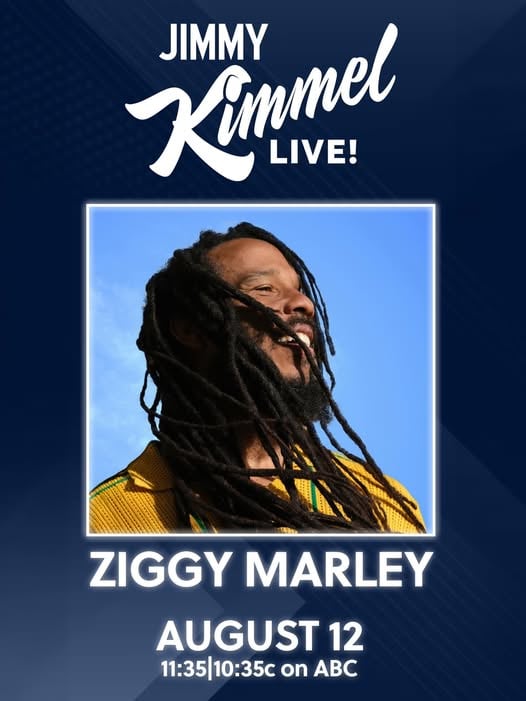
Ziggy Marley is taking "Racism Is a Killa" to Jimmy Kimmel Live, and he is not soft-pedaling what it took to get there. In his own words, Kimmel's show was the only U.S. national TV booking that said yes to the song.
The announcement
Marley posted the news himself on Facebook, writing that viewers should watch him on Jimmy Kimmel Live and tagging the track as #RIAK. He made the barrier plain: no other TV show would agree to let him play this song live on national television in the USA.
That is not a routine promo caption. It is an artist drawing a bright line around broadcast comfort zones, and naming the one team that crossed it.
"No other TV show would say yes to me playing this song for their audience live on national TV in The USA."
Why the title alone changes the booking math
A song called "Racism Is a Killa" does not leave much room for soft framing. Marley's point is that American broadcast media still flinches when a title carries an explicit social charge. Most bookers passed. Kimmel's team, he said, was "brave enough to green light" the performance into American households.
Framing the yes as bravery rather than courtesy tells you how he reads the landscape. This was not treated as a standard late-night music slot. It was treated as a deliberate call.
Reggae, protest, and prime-time television
Reggae has a long tradition of putting hard truths on melody, from Bob Marley's generation through Ziggy's own catalogue. Getting that lineage onto U.S. late-night TV still matters because the medium reaches people who will never sit in a Kingston session or scroll a reggae timeline first.
Expect split reactions. Some will praise Kimmel for platforming an artist with something real to say. Others will ask why the rest of the industry closed the door, and what that says about where broadcast culture draws its lines in 2026.
What to watch next
The appearance was flagged for the following night after his post, so the window to catch it live was short and intentional. Whether you tune as a reggae fan, as someone following Marley's activism, or as a curious late-night viewer, the conversation around the booking is already bigger than a single song cue.
Marley closed the note with "JAH," a sign-off that needs no translation for anyone who knows his family's lineage. For Jamaica and the wider Caribbean music audience, seeing that message land on U.S. national TV is the headline under the headline. Watch the performance, then watch how the room talks back.

